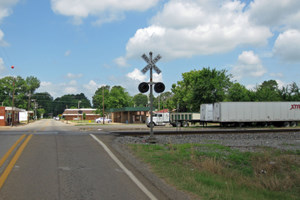
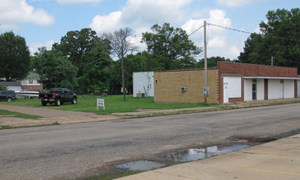
Demolition of Old Post Office/Bank Building, 1978

The following article, entitled “Big Store No More,” appeared in the Lafayette County Democrat of September 21, 1978, and is reprinted here by permission.  It contains a few minor inaccuracies, but is nevertheless an excellent narrative concerning the building it describes and early Bradley history.  It was written by John A. “Ardis” Manry, who was a resident of Plain Dealing, but had a keen interest in the history of this entire region.  In the later years of his life, his eyesight was quite poor, but it never stopped him from having a cheerful disposition, especially when he could talk about local history.  The photo below is quite grainy because is copied directly from the newspaper.

Big Store No More photo 

By John A. Manry

The tearing down of three old store buildings, brick by brick, is underway and if bricks could tell everything that had happened there since the beginning of this century, and if the land on which it stands could only tell something of its owners since it was bought from the Government before the Civil War, it might go like this:

The name of the buildings have been changed from time to time, depending [on] who owned them.

Records in the courthouse at Lewisville show that the land was bought from the Government by Alexander T. Evans.  Census records kept by the Lafayette County Historical Society show that he and his brother, James K. Evans, both born in Georgia, came here from Alabama with large families, built homes nearby, and both entered the Confederate Army.

Each married daughters of Mr. and Mrs. Elisha Waldrop and were active in the Methodist Church there.  It was in the winter of 1867 [when] they were instrumental in arousing the countryside by preaching that converts came pouring in.

It was a part of the “Great Awakening” prevalent over our country at that time, but descendants of these people living at Bradley still refer to the great awakening at nearby Walnut Hill as that “Christmas meeting.”

The records are not too exact why the Bradley land was sold or lost, but possibly it was lost because of educating so many of the Evans family to the ministry.  Some say eight of the boys became ministers, mostly Methodist, of course, but there was a sprinkling of Baptist, too.

By 1885 Cassius Leigh owned the land.  That year he deeded it to a H. G. Allis, who is believed to have been a land speculator anxious to make a profit.  He sold it to the Southwestern Improvement Association just before the Cotton Belt decided to extend their railroad from Lewisville to Shreveport in 1888.

COMING OF RAILROAD

The Southwestern Improvement Assoc. had played an important part in laying out the town of Galveston, where Lewisville is now, and other towns along the Cotton Belt by selling off lots, making a profit and moving on.

It was 10 years later that the Improvement Association sold this part of land to D. D. Hamiter, a son of John H. Hamiter and a grandson of John Hamiter who had moved to the northern part of Bossier Parish in the 1840’s from Houston County, Georgia.

A glance at the valuation of this land showed that it was tripled in value during the year 1900, indicating that some improvements had been made on the property then.  Sometime later another brick building was built alongside it.

FIRST TELEPHONE HERE

While D. D. Hamiter operated the store he was acting depot agent.  In time his brother Eugene became a partner, and they called their store the Hamiter Brothers Mercantile Company.

Mrs. Aletha Hamiter Barker, now a resident of the Homestead Manor Nursing Home in Stamps, in her “Scrapbook of Roane Township,” writes that “when the telephone system was first organized (1901, in Walnut Hill), there was only one phone in Bradley and it was in Hamiter Bros. store.  Anytime, day or night, a person wanted to call a doctor, or on account of a sudden death or accident, some member of the mercantile company had to get up and go open the store and stay until the necessary call was completed.  Usually, some of the clerks slept in the store for this purpose,” she said.

BRADLEY BECOMES A VILLAGE

By 1905 the residents of Bradley petitioned the County Court to become a village and the streets were laid off into 21 blocks, starting from present-day Highway 29, which was called Express Street, and all but one street running parallel with it were named after parts of a train.  They were Coach Street, Cab Avenue, Pilot Avenue, Pullman Street, and then Woodruff Street, perhaps named for the publisher of the Arkansas Gazette.  Cross streets were numbered from First to Seventh from the Methodist Church on the south, to the present-day Baptist church on the north.

This placed the brick store buildings on the corner of Pilot Avenue and Fourth Street, now known as Highway 160 West.

In 1911 J. B. Burton, Sr., bought the property from the Texarkana National Bank and Olin Longino [began] operating a store there known as Burton and Longino.  Burton’s heirs sold to B. G. Jester and the Jester heirs sold to Richard D. Smith of Bradley.  This year, the building was sold to Lane Pierce, president of the Bank of Bradley.

In the early days the stores all faced the railroad, but the coming of the automobiles cause them to face the highways and such happened to this old store building.

HOUSED POST OFFICE

In 1939 the U. S. Government leased the corner building for a post office.  It remained here until their present post office was built.

FIRST BANK BUILDING

The Bank of Bradley was organized in September of 1912, and the third brick building was built.  A big barbecue was given and this event attracted crowds of hungry visitors, the Democrat reported.

This building came into the news again when it was robbed  by three professional bank robbers escaping with $312, all the money they could find in the open trays on the bank’s counter.  The vault, they could not open.  It became such a bastion in time that Frank M. Cochran, Jr., bought the old vault door as a reminder of how it had withstood the robbers.

Eventually one of the robbers was sentenced to Alcatraz and is said to have offered to return his part of the loot, but it was never received.

It’s gone today.  It will be missed.  It was THE big store in its day and old-timers will never forget how majestically it reared its head through its 78 years of service.  Peace to its brick dust!
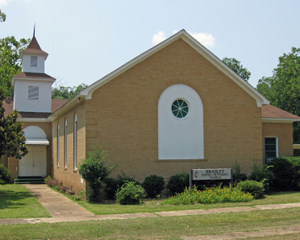
Dedication of Methodist Church Sanctuary, 1949

One of the most beautiful buildings in Bradley is the Bradley United Methodist Church sanctuary:

 IMG_0091 B

This building was dedicated in 1949.  The following article appeared in the Lafayette County Democrat of Friday, May 13, 1949, and is reprinted here by permission.

“METHODIST CHURCH AT BRADLEY TO BE DEDICATED MAY 15TH

Sunday, May 15th, at 11:00 a.m., Bishop Paul B. Martin will dedicate Bradley’s new Methodist Church building.  He will be assisted in the service by Rev. J. M. Hamilton, District Superintendent, and several former pastors.  Rev. Edwin Keith will preside.

Mrs. J. M. Allen and Miss Hortense Hamiter will have charge of the music.  Dinner will be served on the lawn.

Mrs. J. W. Camp and Mabel McGill were appointed to select the committees for the occasion and have chosen the following:

Invitation—J. M. Allen, Mrs. J. W. Camp.

Worship—Miss Hortense Hamiter, Mrs. J. M. Allen, Mrs. J. W. Camp.

Reception—Mrs. W. A. McGee, Mrs. L. B. Hamiter, Mrs. Mabel McGill, J. B. Edwards.

Decoration—Mrs. Mabel McGill, Mrs. Ed O’Neal, Mrs. T. H. Dismukes.

Dinner—Mrs. George Davis, Mrs. L. G. Middlebrooks, Mrs. L. B. Hamner, Mrs. J. W. Meek, Jr.

Publicity—Mrs. Aletha Allen.

The church building was started in 1946, under the leadership of our pastor, Rev. M. E. Scott, and was completed in the summer of 1947.  The first service was held in it August 9, 1947, with Rev. M. E. Scott preaching and Rev. J. A. Simpson, pastor at that time, presiding.

The building is a brick veneer which cost approximately twenty thousand dollars.  It has a seating capacity of approximately one hundred and twenty-five, pastor’s study, seven Sunday school rooms and two rest rooms.

The building committee was comprised of the following members:  J. B. Edwards, J. W. Meek, L. E. Taylor, Lee Crabtree and J. M. Allen.

This summer marks the forty-sixth anniversary of the organization of the Methodist church here.

Plans for this church began to be formulated in the summer of 1902 by the late D. D. Hamiter.  The first step was to get a building site.  On September eleventh, 1902, an acre of ground was deeded to D. D. Hamiter, J. H. Hamiter, and T. J. Evans, trustees of the Walnut Hill Circuit of the Little Rock Conference, by the Red River Land Company for that purpose.  On December 3, 1904 an adjoining strip of land was deeded to them by T. J. Evans.

For some reason the organization of the church was not consummated until the summer of 1903, when the late Dr. J. L. Cannon graduated from Southern Methodist University and was sent here as a substitute for Rev. George N. Campbell.

The charter members of the church were Mrs. Lula Brock, Mrs. Lena Adams, Mrs. Lucy Ham, Mrs. Henry Hanson, Mrs. Dora Garner, Mr. and Mrs. A. J. Price, D. D. Hamiter.  All have passed on except Mrs. Dora Garner, Mrs. Lula Brock and Mrs. Henry Hanson.

Under the direction of Dr. J. I. Cannon a frame building was started but was not ready for occupancy until the latter part of 1904.  In the meantime, preaching services were held one Sunday afternoon of each month in the Lodge Hall above what was known as Brock & Smith store and post office on Pilot Avenue.

During the left of the church the following ministers have served as pastors, J. L. Cannon, C. W. Musgrove, R. J. Roland, J. J. Mellard, R. J. Raiford, W. C. Hilliard, H. W. Hansford, M. K. Rogers, A. P. Flowers, Roy E. Fawcett, J. A. Save, G. W. Cannon, C. E. Whitten, R. R. Moore, A. W. Hamilton, M. E. Scott, J. A. Simpson, [and] Edwin Keith.  D. D. Hamiter served continuously on the board of Stewards from the Church’s organization until his death in 1931.

Under the leadership of Rev. Edwin Keith, last year, the old frame church building was converted into a lovely six room and bath parsonage.

During World War II, the church kept a list of all its members entering the services.  This list contains 34 names.  All the boys returned except one.

Sunday School has been held regularly since March, 1912.  Jack Meek is the present Superintendent.  The Sunday School assumed the responsibility of furnishing most of the parsonage when it was completed last year.

The W. S. C. S. was organized in 1920 and has met regularly since that time.  Mrs. J. B. Edwards was the first president.  The present incumbent is Mrs. F. P. Adams.  They have chosen as their special project the beautifying of the grounds of the church and parsonage.

The Methodist Youth Fellowship was organized in 1946.  Mrs. J. M. Allen is Superintendent of Youths’ Work.”

– – –

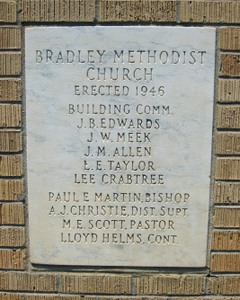
Below is an image of the cornerstone of the Bradley United Methodist Church:

IMG_0095 B 

“BRADLEY METHODIST

CHURCH

ERECTED 1946

BUILDING COMM.

J. B. EDWARDS

J. W. MEEK

J. M. ALLEN

L. E. TAYLOR

LEE CRABTREE

PAUL E. MARTIN, BISHOP

A. J. CHRISTIE, DIST. SUPT.

M. E. SCOTT, PASTOR

LLOYD HELMS, CONT.”

A Tale of Two Sanctuaries

Below is an image of the 1903 sanctuary of the Bradley Baptist Church which appeared on the church bulletin on the occasion of the 90th anniversary of the Church in 1992.

BBD 1903 Sanctuary

On November 17, 1963, the Bradley Baptist Church celebrated Dedication Day of its new (current) sanctuary:

BBC Dedication Program 1963

“Bradley Baptist Church

Jim Powell, Pastor

Bradley, Arkansas

November 17, 1963

PURPOSE OF DEDICATION DAY:

To dedicate a sanctuary built by our hands to the total honor of God, the Father, Son and Holy Spirit.

‘Except the Lord build the house, they labor in vain that build it…” —-Psalm 127:1a.’”

– – –

Space limitations prevent a full transcription of the program of the morning worship service on that day, but the individuals listed on the program were as follows:  Prelude by Mrs. T. E. Cason; Greetings From Hope Baptist Association by M. T. McGregor; Solo—”Dedicatory Hymn,” by Mrs. L. A. Bishop; Solo by Mr. Mack Jackson; and Message of Dedication by The Pastor.

(As a point of historical reference, it can be noted that this service occurred just five days prior to the assassination of President John F. Kennedy in Dallas, Texas.)

– – –

A little over three years later, on Sunday, December 25, 1966, Christmas Day, the Bradley Baptist Church gathered to say goodbye to the 1903 sanctuary.

Bradley Churches red notebook 075 B

“A Convocation of FAREWELL

Old Church Building

Bradley Baptist Church

December 25, 1966

Hymn 8

Scripture – Romans 12:1–12

Prayer

Hymn 167

Announcements concerning our New Building”

– – –

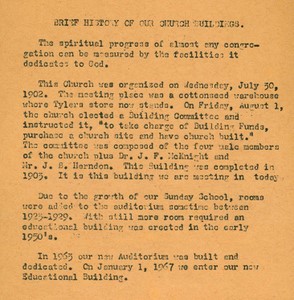
The third page of the program for this event contained a brief, but very useful history of the various buildings of the Church at that time.

Bradley Churches red notebook 076 B

“BRIEF HISTORY OF OUR CHURCH BUILDINGS.

The spiritual progress of almost any congregation can be measured by the facilities it dedicates to God.

This Church was organized on Wednesday, July 30, 1902.  The meeting place was a cottonseed warehouse where Tylers [sic] store now stands.  On Friday, August 1, the church elected a Building Committee and instructed it, “to take charge of Building Funds, purchase a church site and have church built.”  The committee was composed of the four male members of the church plus Dr. J. F. McKnight and Mr. J. B. Herndon.  This Building was completed in 1903.  It is this building we are meeting in today.

Due to the growth of our Sunday School, rooms were added to the auditorium sometime between 1923–1929.   With still more room required an educational building was erected in the early 1950’s.

In 1963 our new Auditorium was built and dedicated.  On January 1, 1967 we enter our new Educational Building.”

– – –

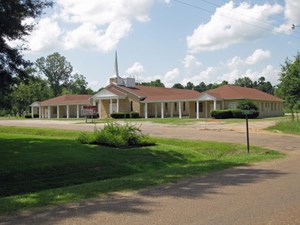
For those who may not be completely familiar with which building is which, in the color picture of the three buildings in the July 9, 2008, post on this blog, they are, from left to right:  1966/1967 educational building; 1963 sanctuary; early 1950’s educational building.

– – –

And for the benefit of anyone who may demand equal time, the next post on this blog will deal with some of the historical aspects of the Bradley United Methodist Church.  If any readers have information they would be willing to share with this site’s other readers on the history or buildings of any of the other churches in the Bradley area, I would be most interested and appreciative.

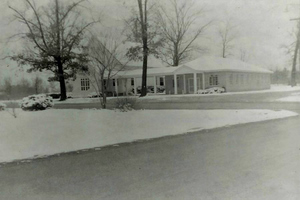
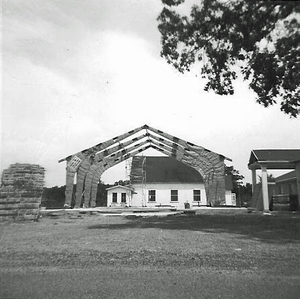
Bradley Baptist Church, circa 1960

The image below, courtesy of Mrs. Marjorie Bishop, shows the Bradley Baptist Church after a snowstorm in 1960.  Following that image is a picture taken from approximately the same place and angle on the hot summer afternoon of July 6, 2008.

010 C

IMG_0007 B

The sanctuary in the top image was replaced by the one in the bottom image in 1963.  Below is a picture taken during that construction, which shows the old sanctuary moved to the rear of the property during that construction.  It continued to be used in its new location until the construction of the new sanctuary was completed.

011 B

As is apparent, the colonnade between the educational building on the right side of the 1960 image was severed, then reattached to the new sanctuary when it was completed.

Sometimes history is right out in plain view, staring us in the face, and yet we seldom notice.  One example is cornerstones.  Although it is now partially obscured by a shrub, the cornerstone for the present (1963) sanctuary is shown below:

IMG_0033 B

It reads:

“BRADLEY BAPTIST

CHURCH

——-

ORGANIZED

JULY 30, 1902

THIS SANCTUARY

ERECTED 1963

‘JESUS CHRIST HIMSELF

BEING THE CHIEF CORNER

STONE’ EPH 2:20”

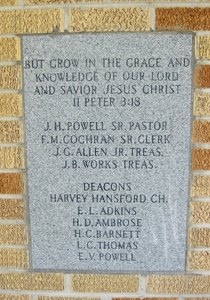
The building on the left side of the current (color) photo was completed in 1966.  Below is an image of its cornerstone:

IMG_0035 B

It reads:

“BUT GROW IN THE GRACE AND

KNOWLEDGE OF OUR LORD

AND SAVIOR JESUS CHRIST

II PETER 3:18

J. H. POWELL SR. PASTOR

F. M. COCHRAN SR, CLERK

J. G. ALLEN JR. TREAS.

J. B. WORKS TREAS.

DEACONS

HARVEY HANSFORD CH.

E. L. ADKINS

H. D. AMBROSE

H. C. BARNETT

L. C. THOMAS

E. V. POWELL”

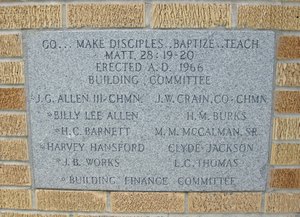
There is an enclosed hallway between the rear (north) end of the 1963 sanctuary and the 1966 building which also has a cornerstone/commemorative marker, shown below:

IMG_0038 B

It reads:

“GO … MAKE DISCIPLES .. BAPTIZE .. TEACH

MATT 28: 19–20

ERECTED A. D. 1966

BUILDING COMMITTEE

*J. G. ALLEN III CHMN.        J. W. CRAIN. CO-CHMN.

*BILLY LEE ALLEN               H. M. BURKS

*H. C. BARNETT                 M. M. McCALMAN, SR.

*HARVEY HANSFORD           CLYDE JACKSON

*J. B. W0RKS                     L. C. THOMAS

*BUILDING FINANCE COMMITTEE”

– – – – – – – – – –

Again, thanks to Mrs. Marjorie Bishop for the use of the two black-and-white photos.

Wet Or Dry? 1949 (Part 3 of 3)

There was yet another county-wide local option election on the question of alcohol sales and transfers in 1949.  It is not clear from the County Court’s Record Book who the petitioners were or what their motives were.  On August 2, 1949, County Judge A. B. Parker considered “certain petitions” for such an election and ordered that election to be held on August 30, 1949 (County Court Record “T,” at page 500).

On September 2, 1949, Lafayette County Election Commissioners A. S. Bray, T. M. Black and A. L. Mashaw reported the results of the election to the County Court (County Court Record “T,” at page 505).  The “drys” won the election by the most lopsided margin of any local option election to that time, 1,234 dry to 269 wet.  The only precinct in the entire county that voted wet, by a margin of 21 to 16, was the Boyd Hill precinct in the northwest part of the county.

One of the more interesting facets of this particular election is the list of poll workers in each precinct, the great majority of whom were paid the princely sum of $4.00 for their efforts on the day of the election.  Results from the precincts in the southern part of the county and the poll workers for each precinct are listed as follows:

Bradley:  10 wet, 147 dry; Charlie Crabtree, J. R. Cochran, Homer Enyart, Mrs. Allie McDonald, Miss Birdie Crabtree, Mrs. Bessie Cochran.

Gin City:  3 wet, 47 dry; Byrd Powell, Herman Barnett, Mrs. Herman Barnett, Wylie P. Cryer, Mrs. Clyde Jackson, W. L. Blunt.

Hackney:  0 wet, 27 dry; Mrs. Mabel McGill, Mrs. Roy Barker; Mrs. L. G. Middlebrooks, Mrs. W. E. Rich, Mrs. W. A. McGee.

Canal:  1 wet, 15 dry; C. G. Taylor, L. M. Poole, Mrs. L. M. Poole, J. L. Wilson, Johnie Keahey.

Canfield:  6 wet, 31 dry; Ura Lynn, R. M. Moncus, Mrs. W. R. Smeltzer, Mrs. Odell Clary, L. D. Stuart, W. E. Copeland, Jr.

State Line:  0 wet, 19 dry; E. C. Allen, Mrs. E. C. Allen, Mrs. Jessie Watkins, Clyde Berry, Lee Maness, J. F. Tyler.

Walkers Creek:  13 wet, 33 dry; Phoenix Fish, N. L. Fish, J. N. Barnes, Earl Owens, Jess Taylor, Marvin Whitehead, E. H. Orr.

With this election in 1949, Lafayette County, including Bradley, remained “dry.”

Wet or Dry? 1945 (Part 2 of 3)

There was another, county-wide, local option election in 1945 on whether alcohol sales or transfers should be allowed.  That election, of course, affected Bradley and Roane Township just as much as the remainder of Lafayette County.

The 1945 election began when some petitioners, led by Rev. Fred A. White, pastor of the First Baptist Church of Lewisville, presented their petition to hold an election to County Judge A. B. Parker.  On January 22, 1945, Judge Parker set a hearing on the petition for January 29, 1945. 

On the hearing day of January 29, Judge Parker found that the petitions to hold an election were sufficient and ordered a special election to be held on February 27, 1945.  An excerpt from Judge Parker’s January 29 order:

“Whereas at the time, place, date and manner of said ‘Public Hearing’ as set out in ‘Public Notice of same,’ did appear many qualified electors and/or voters in Lafayette County, Arkansas the said Rev. Fred A. White, upholding the validity of said petitions and qualifications of signers thereon, and a ‘general objection’ made by Pat Robinson, a regular license [sic] and practicing lawyer within the State of Arkansas as to the ‘invalidty of said petitions only’, together with oral argument, discussion, and debate of said petitions which were offered and open in said Court as evidence, the Court doth find that said petitions are sufficient and said petitions are signed by fifteen percent (15%) of persons who have paid their poll tax, and in accordance with law are qualified voters and/or qualified electors in and for Lafayette County, Arkansas as of the 22nd day of January, 1945.”  (County Court Record “T,” at page 169.)

Some members of the public were apparently not satisfied with Judge Parker’s ruling in the County Court, and filed an appeal to the Circuit Court.  Judge Parker entered an order granting that appeal, noting that it was requested by “John Coleman, V. J. Emerson, H. A. Fuller, Mark Jarnigan and A. A. Williams.”

The issue on the appeal to Circuit Court involved special federal rules in wartime allowing servicemen to vote, whether they were registered locally and had paid their poll tax (later found unconstitutional by the U. S. Supreme Court) or not.  The Circuit Court upheld the legality of the original petitions.  Its Order, recorded in Lafayette County Circuit Court Record 17, at page 633, stated in part:

“…the court doth find that said petitions praying for an election to be held … are sufficient, , said petitions having been signed and acknowledged by 509 persons who are qualified votiers [sic] and/or electors in and for Lafayette County, Arkansas at the time said petitions were filed.  That at the time said petitions were filed there were 2,358 qualified electors, as shown on the poll-tax records of Lafayette County, Arkansas, who having paid their poll tax in the manner and within the time as required by law and possessing all other requirements of a qualified elector.  That in addition to paid poll-tax from the records in evidence, at the time of the filing said petitions there were 981 men and women (white and black), residents of Lafayette County, Arkansas serving in the Armed Services of the United States.  That of this number in the Armed Services there is found to be 129 who are under the age of 21 years at the time of filing said petitions.  There has been 192 discharged from the Armed Services of the United States, and from the Records of the Circuit Clerk of Lafayette County, Arkansas there has been u8 [sic] men and women discharged from Armed Services prior to 7th November, 1944.”  (Circuit Court Record 17, at page 633.)

So, the election was back on, but had to be rescheduled.  The anti-election forces attempted to appeal the Circuit Court’s decision to the Arkansas Supreme Court, but were denied because they did not perfect their appeal in the time limit allowed.  On July 9, 1945, County Judge Parker re-set the date of the election for July 31, 1945 (six days before the first atomic bomb was dropped on Hiroshima, Japan). (County Court Record “T,” at page 205).

On August 2, 1945, County Election Commissioners A. M. Shirey, F. E. Baker, and John F. Riggins, certified the results of the election to the County Court (County Court Record “T,” at page 208). The “drys” won the election 838–538 (61% to 39%).  Precincts in the southern part of Lafayette County voted as follows:  Walkers Creek 32 wet, 8 dry; State Line 16 wet, 4 dry; Canfield 9 wet, 34 dry; Gin City 7 wet, 24 dry; Hackney 9 wet, 18 dry; Canal 10 wet, 14 dry; Bradley 19 wet, 120 dry.

Lafayette County, Bradley included, was henceforth “dry.”


Wet or Dry? 1935 (Part 1 of 3)

Perhaps no issue raises passions in a local election like the question of whether alcohol sales and transfers should be allowed or prohibited.  Most of its current and former residents know that Bradley and Lafayette County are “dry,” but few know precisely how that came to be.  While the most recent “local option” elections have been county-wide, Roane Township once had such an election of its very own, which did not affect the remainder of Lafayette County.

Prohibition had begun in 1920 as the law of the United States by the adoption of the Eighteenth Amendment to the United States Constitution  and the passage of the Volstead Act.  Prohibition was repealed in 1933.  At the time of its repeal, President Franklin D. Roosevelt was quoted as saying, “I think this would be a good time for a beer.”  Roane Township voters apparently thought differently. 

Two years later, on August 6, 1935, Lafayette County Judge A. M. Shirey entered an order in County Court calling a local option election in Roane Township:

“On this 6th day of August, 1935, … is presented the petition of Mrs. J. F. McKnight and 186 other legal voters of Roane Township, Lafayette County, Arkansas, which is 60 per cent of the legal voters of said territory … asking this Court to make an order … directing an election to be held in said territory on 22nd day of October 1935, … upon the proposition whether or not spirituous, vinous, or malt liquors shall be sold, bartered or loaned, therein and specifically requesting that if a majority of the legal voters be opposed to the sale, then barter or loan of said liquors as shown by said election that spirituous, vinous, or malt liquors shall not be sold, bartered, or loaned within said territory, neither shall they be sold by dispensaries, restaurants, hotels or clubs within said territory.”

“It is, therefore, … ordered … that an election shall be held on the 22nd day of October, 1935, within Roane Township, Lafayette County, Arkansas for the purpose of taking the sense of the legal voters in said territory and the
Sheriff, R. H. Duty is hereby directed to open a pole [sic] at each of the voting places within said territory on said date ….”

“In order that the sense of the legal voters of said territory may be determined in said election, the ballot shall read as follows: 

     ‘For sale, barter and loan at wholesale and retail of spirituous, vinous, or malt liquors, in Roane Township, in Lafayette County, Arkansas.

     Against sale, barter and loan at wholesale and retail of spirituous, vinous, or malt liquors, in Roane Township, in Lafayette County, Arkansas.’

….”

This order can be found in County Court Record “S,” at page 88.

With 60 percent of the eligible voters signing the petition to hold the election, the outcome was predictable.  On October 29, 1935, one week after the date of the election, Election Commissioners F. E. Baker, as Chairman, and F. W. Youmans, as Secretary Pro Tem of the Election Commission reported to County Judge Shirey:

“We … certify that the votes as cast at said election were cast as follows to-wit:

     For the sale of Liquors and etc. ——————— 13 votes

     Against the sale of Liquors and etc. ————– 186 votes.

The report of the Election Commissioners can be found at County Court Record “S,” at page 131.

Sophomore Class of Bradley High School, 1940-41

On a sunny day during the 1940–41 school year, the sophomore class of Bradley High School gathered in front of the two-story high school building to have their picture taken.

Unlabeled 1 1-2 blue 020 C

Front row, left to right:  Tom Burchett, Jr., Odis Walker, Bunny Jackson, Jackie Crabtree, Danny Collins, Jesse Daley, Gerald Hollis, Buddy Allen, Howard Bird.  Back row, left to right:  Kathryn Jones (Alegbra II teacher), Laura Jane Cochran, Frances King, Nell Ruth Love, Louise Dodson, Annie Marie Twitty, Betty Jo Pritchard, Alice Louise Lester, Mary McGill, Julia Ann Montgomery, R. W. Knight (sponsor).  Not pictured is another member of the class, Leah Somers.

Downtown Bradley, late 1950’s

Shown below are four black-and-white photos taken in “downtown” Bradley, apparently in the 1950s.  I don’t know who took these photos, but they were apparently taken on the same roll of film.  The photos are actually copies of copies and, therefore, rather grainy, and one is slightly out of focus.  After each of these photos is a color photo taken from approximately the same location and angle on June 15, 2008.

The first photo is of Fourth Street (Highway 160).  The Coca-Cola sign on the building on the left says “J. M. Drake.”  The building on the left must have been demolished not very many years after this photo was taken.

Gray 2-inch 042 B

IMG_9575 B

– – – – –

The second photo shows a group gathered around a ladder, perhaps, judging from the jackets some are wearing, putting up Christmas lights.  Again, the building in the background must have been demolished not very many years after this photo was taken.

Gray 2-inch 040 B

IMG_9569 B

– – – – –

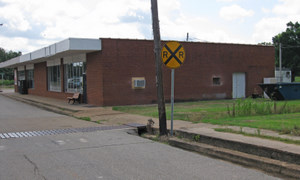
The third photo shows the view from just east of the railroad depot on Fourth Street/Highway 160, looking west.  It also shows what was then the front entrance to the depot.  The building in the background was demolished in 1978.

Gray 2-inch 039 B

IMG_9583 B

– – – – –

The fourth and last photo shows the building in which George Bell later published the Bradley Pioneer for 16 years.  It was demolished in the mid-1980’s.  The Bradley Public Library was located in the right side of this building for many years.  The sign on the side of the building says, “Jones Plumbing and Electric.”  To the right of that building is Alvin Owens’ barber shop.

Gray 2-inch 041 B

IMG_9561 B

– – – – –

These photos remind me of a book that, as a boy, I spent literally hours poring over at the Bradley Public Library.  It was a large (perhaps 24 inches by 30 inches) scrapbook or photograph album put together by the Bradley B. & P. W. Club.  It contained many, many wonderful photographs of Bradley as it appeared in the 1950s.  I’ve often wondered whatever happened to that scrapbook.  If any of the readers of this site know of its present location, I would be most interested to learn its whereabouts.


J. B. Herndon of “Bradley Station”

In 1890, Goodspeed Publishing Co. of Chicago, Nashville, and St. Louis, published its Biographical and Historical Memoirs of Southern Arkansas, which was one of a series of many such books covering various areas of the southern United States.  These books usually relied on information supplied by the subjects of the biographies themselves, and were hardly objective.  Nevertheless, this particular book and similar books for other areas contain some interesting historical and biographical information. 

The name of J. B. Herndon has previously appeared on this site as an incorporator and stockholder of the Walnut Hill Bank (see posts of 1/7/08 and 2/5/08).  He is also profiled in this particular Goodspeed’s, as follows:

“J. B. Herndon, the popular merchant of Bradley Station, was born in the county on February 9, 1860, and here he attained his growth and was schooled, received the best education that common schools afforded.  He was married September 20, 1888, to Miss Lola Velvin, who was born in Georgia in 1867.  Her father, R. C. Velvin, is now living in Texas.  Their marriage has been blessed in the birth of one child, a daughter—Ella W.  In 1885 Mr. Herndon began life’s battles for himself by engaging in the saloon business on Red River, but in 1888 he disposed of these interests, and opened a general store in Walnut Hill, continuing there about one year, and then came to Bradley.  Here he commenced a general merchandise business, which he has successfully conducted ever since, carrying a stock valued at $2,500, and he is conceded to be a very capable young business man.  His wife is a member of the Baptist Church, in which she is one of the most active workers, and is an intelligent and amiable lady.  J. B. Herndon is one of seven children—three boys and four girls—born to the marriage of J. D. and Eliza (Cramtree [sic?] ) Herndon, both of whom were natives of this country and are now deceased.  The father departed this life in March, 1872, and his widow on January 1, 1880.  The paternal grandfather was a native of Kentucky, and emigrated to Arkansas at an early day, being one of the early pioneers of this State, and here he passed the remainder of his life.  He was a farmer by occupation, as was his son also, the father of our subject.  Five of the seven children born to the parents are still living:  “Zurie (deceased), Mattie (deceased), Ida, J. B., R. F., Lola and J. D.”

Glynn McCalman’s book, Bradley Connections, furnishes many more details regarding the Herndon family and the contributions it made to this area.  

One wonders just how many saloons there were on Red River in the late 19th century, and whether Mr. Herndon “disposed” of his saloon because there were too many other saloons in competition with his or whether the river traffic had declined, probably due to the coming of the railroads, to the point where the business was no longer profitable.

The reference to “Bradley Station” is probably how the local stop on the St. Louis Southwestern Railroad was designated before the Town of Bradley was formally incorporated in 1905, some 15 years after the publishing of this book in 1890.