Letter from an American Hero (Part 2 of 2)

I asked Glynn McCalman, Clyde Vernon McCalman’s brother, to write a paragraph or so describing Clyde as he was before he entered the U. S. Army, and Glynn was kind enough to provide the following:

“Clyde Vernon McCalman was born June 13, 1923, to Odell and Gertrude McCalman at their farm home on the old Shreveport Road south of Walnut Hill.  He and his brothers, Marvin, Byrd and Glynn, attended school at Bradley, where Clyde excelled academically and socially.

Clyde continued to excel as a student at Ouachita College during the early years of World War II.  He was exempted from service in the war because of his status as an ordained minister, but he was uncomfortable with that exemption.  After the death of a close cousin, neighbor and friend, Harland Bird, in a bombing raid over Germany, he felt compelled to offer himself in the conflict.

He volunteered for service in the Army on March 17, 1944, and was killed on the same day one year later, March 17, 1945, in the final weeks of the war in Europe.  The letter (in the previous post) was written in the month preceding the month of his death.”

Thanks to Glynn McCalman for providing the above information.  For any reader of this site who may not already be aware of it, Glynn is a Bradley area historian and the author of two books on local history:  Bradley Connections and Walnut Hill And Somewhere Else.

– – – – –

Clyde’s letter touches on several aspects of an infantryman’s life during active combat, such as the simple pleasure of sleeping inside a building.  Perhaps it may be useful to add a clarifying comment to some passages from the letter.

There is a reference in the first paragraph to someone named Hogue.  I have no idea who this was, other than someone who was obviously a mutual acquaintance of Clyde and my father.

The third paragraph of the letter refers to the “big German counterattack” and the awful winter weather.  This is a reference to what we now call the Battle of the Bulge, which began shortly before Christmas in 1944.  It was Hitler’s last serious attempt to break out of the encirclement into which the Allied advances had forced him.

The fourth paragraph of the letter states that “It was my division which cut off the Cherbourg Penninsula and took 1/4 of all prisoners taken on Cherbourg.”  This refers to combat operations shortly after D-Day, June 6, 1944, when the Allies landed on the beaches of Normandy in France.  Cherbourg, with its fine port facilities which the Allies coveted and which the Germans were determined to defend long enough to destroy, was taken on June 30, 1944. 

Clyde states in the letter that he has “five months of combat behind me,” so it is doubtful that he was personally engaged in active combat during the Cherbourg operations.  Indeed, that would have occurred only a little more than three months after his enlistment in the U. S. Army.  It does, however, provide an idea of how long his unit had been actively engaged with the Germans.  Another indication of constant attack operations by the U. S. Army can be found in the comment in the next-to-last paragraph that “We have not been farther back than our own artillery since early October.”

It is ironic that Clyde’s letter states that he had “a comparitively soft job – mil clerk and administrative assistant to the 1st Sgt,” yet he was killed in action a little more than one month later.  This is perhaps an indication of the ferocity of the fighting, the urgency to maintain the attack, and the need for every soldier, including the ones with a “comparatively soft job,” to actively participate in the fighting.

– – – – –

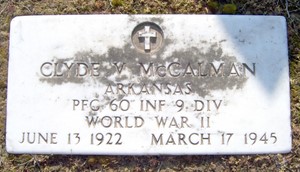
Pfc. Clyde Vernon McCalman’s remains were temporarily interred at Henri-Chapelle in Belgium and were later moved to the Walnut Hill Cemetery.  Below is an image of the foot marker on his grave:
Letter From An American Hero (Part 1 of 2)

Clyde Vernon McCalman was the son of Mr. R. Odell McCalman and Mrs. Gertrude McCalman.  He was born on June 13, 1923.  In February of 1945, he was serving as a Private First Class with the United States Army on its final push into Nazi Germany.  On February 6, 1945, he wrote the following letter to Frank M. Cochran, Jr., who was serving with the United States Army in the Pacific theater.  A verbatim transcription of the letter follows the images.

                                          “Germany

                                           February 6, 1945

Dear Frank M;

     Recieved your letter of Dec. 27 today and was very glad to hear from you again.  Had a brief letter from Hogue recently saying you had moved but didn’t know you were in Air Corps.

     To be sure things are pretty rough over here but so far as I am personally concerned I can not complain — naturally, with five months of combat behind me, as an infantryman I have had some close calls — God has been good to me.

     I find it amazing how much a fellow can take when the chips are down —the big German counterattack was bad enough without the 20 degrees below weather and snow about 3 or 4 ft. deep usually.  For the past few days our Ninth Div has been making the headlines — as it did in Africa, Sicily, France, Belgium, and now Germany — It was my division which cut off the Cherbourg Penninsula and took 1/4 of all prisoners taken on Cherbourg.

     We got quite a bit of “loot” off of prisoners — I sent a good German compass home yesterday for which I was offered $10.  Could easily have sold it for twice that much.

                                              2

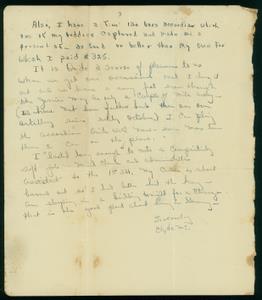
     Also, I have a fine 120 bass accordian which one of my buddies captured and made me a present of — as good or better than my own for which I paid $325.

     It is quite a source of pleasure to us when we get our occassional rest.  I drag it out and we have a song fest even though the Jerries may be only a couple of miles away— (We have not been farther back than our own artillery since early October.)  I can play the accordian quite well now — even more tunes than I can on the piano.

     I “lasted long enough” to rate a comparitively soft job — mil clerk and administrative assistant to the 1st Sgt.  My candle is about burned out so I had better hit the hay — Am sleeping in a building tonight for a change.  That is the good part about being in Germany —

                                             Sincerely

                                             Clyde Mc.”


     On March 17, 1945, exactly one year after he enlisted in the U. S. Army, and exactly 39 days after he wrote this letter, Pfc. Clyde Vernon McCalman was killed in action in Germany.  He was 21 years old.

Governor Conway Days 2008–Scenes And People

On Saturday, March 29, 2008, Bradley celebrated its annual Governor Conway Days.  Shown below are photos depicting some of the happenings and people who were there.  In contrast to the usual method of describing photos on this site, captions have been placed under the photos.

01-100_5888-b.jpg

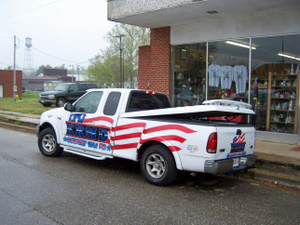
Radio station KRMD was there Saturday morning.

02-100_5889-b.jpg

Joe Middlebrooks models one of the world’s most hideous hats.

03-100_5881-b.jpg

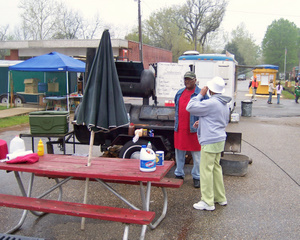
One of my favorite parts of Governor Conway Days is the food from the Providence Baptist Church.

04-100_5969-b.jpg

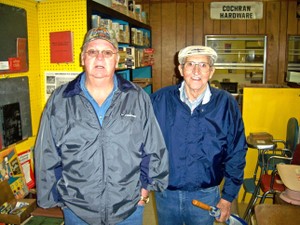
The Cochran Museum was open from 10:00 A.M. to 4:00 P.M., except for the parade.

05-100_5895-b.jpg

Gene Smith and Lonnie Jernigan.

06-100_5897-b.jpg

Dickie Bishop, Linda Lamar Mehrling, and Loretta Thompson Rodgers.  (I hope I spelled Linda’s last name correctly.)

07-100_5900-b.jpg

Patsy Vines and LaDonna McClain, the Collier sisters.

08-100_5916-b.jpg

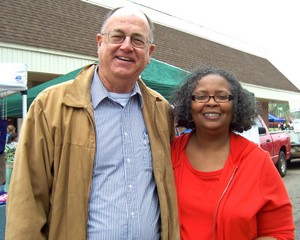
It’s a fairly well-kept secret that I was a teacher in the Bradley Public Schools in the school year 1970–71.  One of my pupils was the lady shown with me above, Janet Sanchez.  Janet is the granddaughter of the late Armie Burrell.

09-100_5906-b.jpg

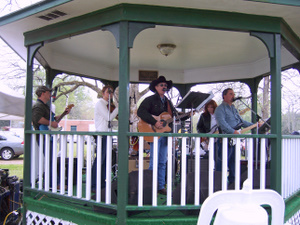
The crowd gathers for some music.

10-100_5917-b.jpg

The gentleman with the guitar on the right is the multitalented Mr. Obie Sims, lately Bradley’s Chief of Police.  Although his Chiefin’ days are over, he is now the maintenance man at the Bradley Public Schools and is also the girls’ softball coach.

11-100_5925-b.jpg

Bradley’s new fire truck had a prominent place in the parade.

12-100_5942-b.jpg

The float containing the Bradley High School Class of 1968, a/k/a the “Great of ‘68.”

13-img_2137-b.jpg

Two of Bradley’s most esteemed senior citizens, Travis Gore and Roy Rogers.

14-100_5967-b.jpg

Susie Cochran Hargis, Jan Allen Segrest, and Brenda Brackman Wayne.

Fourth Street, 1910s

Several previous posts have featured photos from Fourth Street (now Highway 160).  The following photo shows a gentleman whose identity is unknown, but who is obviously very well dressed, standing on Fourth Street in the 1910s.  That date is reasonably certain because of the album from which the photo was taken. 

gray-2-inch-023-b.jpg

This photo is roughly contemporary with the photo on the header of this site and with the first photo in the 1/30/08 post which shows two people standing at the south entrance to the railroad depot.  The buildings in the background face the railroad, as did most of the early commercial buildings in Bradley.  It is difficult to discern, but there is no structure at all on the half-block behind the building at left, which would be where Coker Hardware is now located, and upon which a row of several buildings was later built and also demolished.

This photo is an almost 180–degree opposite view of Fourth Street from the photo in the post of 2/11/08.  The tinted photo of the kneeling man and his dog in that post was taken about 20 years later than this photo, however.

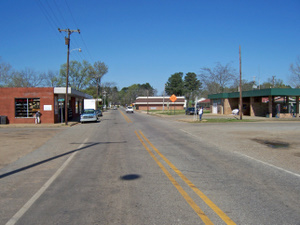
This photo is obviously, judging by the man’s shadow, taken in the late morning.  Below is a photo taken from approximately the same place and angle in the late morning of March 22, 2008.

100_5781-b.jpg

Winter Weather, late 1940s

This past Friday’s late-season snowfall sent me looking for old pictures of winter weather.  The earliest color picture I could find is the one below.  It was taken in the middle of Pullman street in front of where the Bradley Post Office is now located.  I’m less certain of the date it was taken than for many of the other pictures on this site, however.  The date of the late 1940s was arrived at by weighing that (1) this is early color slide film, and (2) the date of the vehicles in the photo, one of which is only partially visible, and shows clearly only at great magnification.

The photo:

39-b.jpg

Below is a photo taken from approximately the same place and angle on the (much prettier) afternoon of March 9, 2008:

 img_0799-b.jpg

Bradley Chamber of Commerce Banquet, 3-1-08

This past Saturday evening, the Bradley Chamber of Commerce held its annual banquet in the Bradley Elementary School Cafeteria, with the usual awards, auctions and fellowship.

State Representative Bruce Maloch conducted two auctions, one of which was the customary auction of this year’s Governor Conway Days T-shirt.  He is shown (hand in air) with Emcee Richard Estes (partially obscured) and Mollye McCalman (holding T-shirt):

IMG_0717B

The Best Ad For Bradley Award was given to Making Rainbows, a child care organization located in the former home of Mr. and Mrs. Roy Tyler. Mollye McCalman presents the award, below, and to Patti Maness and Eileen Cole of Making Rainbows:

img_0725b.jpg

The Community Service Award Award was given to the River Bend Volunteer Fire Department.  Accepting on behalf of the River Bend V. F. D., below, were Jimmie Martin and Roy Tabor:

img_0732b.jpg

Shown below is the head chef of the Bradley Chamber of Commerce Banquet and maker of the world’s best rolls, Mrs. Bennie Ester Harris:

img_0729b.jpg

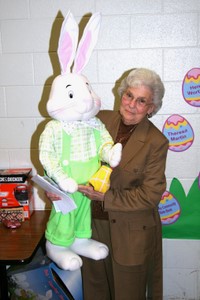
Every Chamber of Commerce banquet features door prizes.  The biggest door prize this year was the bunny won by Mrs. Marian Brackman, below:

IMG_0745B

Tommy Goodwin, editor of the Lafayette County Press, on behalf of the Arkansas Press Association, recognized the family of Gregg and Kishea Koehn as the Lafayette County Farm Family of the Year for 2007.  The Koehn family had another obligation and could not be present.

The annual Governor Conway Days celebration will be observed this year, as always, on the last weekend in March, March 28–29, 2008.

Edwards Company, circa 1940

Edwards Company was located on the southwest corner of Block 9, for the most part between where the Bradley City Hall is now located and Fourth Street/Highway 160.  At one time, Edwards Company was in the dry goods, grocery, and hardware businesses.  Below is an image of the Edwards Company building, taken about 1940.

gray-2-inch-049-a.jpg

The picture is obviously taken in the late afternoon.  The sign near the top of the building on the left side of the picture says “Westinghouse” and “Edwards Company.”  The sign hanging from the awning in front of the left entrance to the building says “Dry Goods,” and the sign to the middle entrance to the building says “Groceries.”  There is a vertical sign behind the car on the right side of the picture that says “Mansfield Tires.”  The hardware part of the business was located in the right side of the building.  The identity of the woman in the picture is not known, but she appears to be in something of a hurry.

Below is a photo taken from approximately the same place and angle on the afternoon of February 26, 2008.

img_0170-a.jpg

Edwards Company, of course, is no longer in business.  I don’t know the dates on which the Dry Goods and Grocery stores ceased business, but did find an old advertisement where the remaining stock of the hardware business was sold at public auction on January 23, 1964.

Walnut Hill Telephone Company: The Early Years

In this age where large telephone companies change their names at a dizzying rate, the name of the company that sends monthly bills to phone customers in Bradley has never changed:  the Walnut Hill Telephone Company.  How did a wide place in the road, like Walnut Hill is today, produce a company which has lasted for over a century?  With help from some of the public records in the Lafayette Circuit Clerk’s Office, we can reconstruct some of the details of the beginnings of the Walnut Hill Telephone Company.

The “Articles of Agreement and Incorporation of Walnut Hill Telephone Co.” are dated April 24, 1901, and can be found in Record Book E-3, at pages 354 to 358.  On that date, at 2:00 P.M., in the office of someone named “S. Hacker” at Walnut Hill, the incorporators of the company held their initial meeting. The incorporators were J. F. McKnight, S. Hacker, D. D. Hamiter, Eugene Hamiter, L. Herndon, Canfield Colbert, J. B. Maryman, Jr., G. M. Lee, R. R. Lee, T. H. Dismukes, and Frank Arline.

The corporation’s proposed business was “…to erect, construct, operate and maintain a local Telephone line and exchange, at and in the vicinity of Walnut Hill, and to erect, construct and maintain a Long Distance Telephone Line and Exchange from Walnut Hill, via Bradley, Frostville, Canfield, and Bolinger, to New Lewisville in Lafayette County, Arkansas.”

 J. F. McKnight was elected President, S. Hacker was elected Vice-President, and D. D. Hamiter was elected Secretary-Treasurer.  The other directors elected were L. Herndon, J. B. Maryman, Jr., G. M. Lee, and T. H. Dismukes.

The capital stock of the corporation was to be $2,500, of which $900 was actually initially paid in by the incorporators.  The value of each share was to be $25. The initial issuance of stock was as follows:  8 shares:  Frank Arline; 4 shares:  J. F. McKnight, S. Hacker, L. Herndon, and T. H. Dismukes; 2 shares:  D. D. Hamiter, Eugene Hamiter, Canfield Colbert, J. B. Maryman, Jr., G. M. Lee, and R. R. Lee.  Ironically, although Frank Arline owned the most shares, he was not elected either as an officer of the corporation or as one of its directors.

A little more than a year after the corporation was formed, on May 17, 1902, it amended its “Articles of Agreement.”  (Record Book H-3, at page 95)  The amount of the capital stock was increased from $2,500 to $5,000, enabling a fresh infusion of capital.  More importantly, however, for the long term future of the company, its purpose underwent a subtle change: “…to own, construct, purchase, operate, and maintain [a] local telephone system in the Town of Walnut Hill and New Lewisville, LaFayette County, Arkansas, and to connect the same by long distance wires, to operate a long distance system between said stations, and to extend and connect it [sic] lines from said points to any points or towns in said county as shall be determined by the directors of said company….”  In other words, instead of one local exchange at Walnut Hill with out-reaching long distance lines, there would henceforth be systems in both Walnut Hill and New Lewisville, which is known today simply as Lewisville.

On August 15, 1905, Walnut Hill Telephone Company filed an “Annual Statement” listing its condition as of July 1, 1905 (Record Book L-3, at page 435).  The Statement reflects $3,700 in “Capital Stock paid in,” “Accounts on hand” of $763.00, and “Cash on hand” of $251.44.  Stock was still valued at $25 per share, but it had undergone a significant growth and redistribution:  G. M. McKnight, 40 shares; J. F. McKnight, 38 shares; T. H. Dismukes, 34 shares; A. H. Hamiter, 22 shares; J. W. Warren, 7 shares; Josie McCormick, 5 shares; and Mrs. C. C. Hamiter, 2 shares. The Statement was signed by J. F. McKnight as President, and by G. M. McKnight as Secretary.

Another “Financial Statement” was filed on August 15, 1908, listing the company’s condition as of July 1, 1908.  (Record Book N-3, at page 585).  Total assets had risen to $7940.96, and the amount of capital stock actually paid in had risen to $4,550.00.  Debts were $3,154.00 and undivided profits of $236.96 were listed.  Stock distribution had changed, but not as drastically as in the previous statement.  G. M. McKnight owned 50 shares; J. F. McKnight and T. H. Dismukes each owned 42 shares; A. H. Hamiter owned 27 shares; J. W. Warren owned 8 shares; C. C. Hamiter owned 7 shares; and Josie McCormick owned 6 shares.

On July 25, 1908, the City of Bradley passed “An Ordinance to Grant Street Privileges for Telephone purposes to Walnut Hill Telephone Co.”  The company received the right for 50 years to “…erect and maintain on the streets, alleys and public way of Bradley, Arkansas, posts, fixtures and wires necessary and convenient for the purpose of supplying to the citizens of said town and public communication by telephone or other electrical device….”  This Ordinance is recorded in Record Book S-3, at page 201, and recites that it was “…passed by the Council, J. W. Barker, Mayor, J. M. Perry, Recorder.”  There is no mention of rates for telephone service in this ordinance.

A similar ordinance was passed by the Town of Lewisville about a month and a half later, on September 7, 1908, although its duration was only for 12 years.  It was recorded in Record Book S-3, at page 202, and was signed by W. J. Harrington, as Mayor, and L. D. Rogers, as Recorder.  The ordinance specified a maximum monthly rate for telephone service of $1.50 for residential customers and $2.50 for business customers. 

Fourth Street, late 1930s

Below is a photo taken on Fourth Street/Highway 160 in the late 1930s.  That approximate date is attributed to the photograph because of the album from which it was taken, and because of the state of the buildings in the photograph.

Gray 2-inch 051 F

Note the orientation of the buildings on both the north and south sides of the street toward the railroad, and not toward Fourth Street/Highway 160 itself, as they later did or as the structures which replaced them did.  The street has obviously not been paved.  The railroad depot can be seen in the distance, just to the left of the kneeling man.

While this may appear at first glance to be a color photograph, it is not.  It a black and white photo which has been “tinted,” a procedure common at that time.  In the interest of full disclosure, however, I have removed some writing that appeared in the shadows on the right side of the photo.  The essential nature of the buildings shown and the man and the dog he is holding have not been changed, though.  I’m not entirely certain of the man’s identity, so I won’t give a name.

Below is a photo taken from approximately the same place and angle in the late afternoon of February 10, 2008. 

img_9744.jpg

The building on the north (left) side of the earlier photo was demolished in 1978 and that site is now occupied by R. B.’s Car Wash.  The building on the south (right) side of the earlier photo has been replaced by the one which now houses, on the far side of it, Bradley Ag Supply.

Walnut Hill Bank, 1907-1913 (Part 2 of 2)

A recent post (1/7/08) provided some details concerning the incorporation and financial operations of the Walnut Hill Bank.  It also left unaddressed two questions concerning that institution: 

(1) Where was the Walnut Hill Bank?  I can’t say with 100% certainty, but I found some clues in the deed records of the Lafayette County Circuit Clerk.  I can find only one parcel of land owned by the Walnut Hill Bank, and would speculate that was the location of the Bank.  It is a very small tract, only about one-fifth of an acre (50 ft. x 165 ft.).  When plotted on contemporary plats of the Walnut Hill area, that tract is located on the east side of the old Washington-to-Shreveport road, just north of where the road to the Walnut Hill Cemetery diverges off to the northwest.  That tract was deeded to the Walnut Hill Bank by J. B. Herndon and Lola Herndon, his wife, on June 6, 1908 (Deed Record O-3, page 273).  The consideration for the transfer of this small tract was $563.54, indicating that there was probably a building already located on the tract.  J. B. Herndon was one of the incorporators of the Walnut Hill Bank, its first president, and it was in his office that the initial meeting of the incorporators was held on December 11, 1907.

(2)  What became of the Walnut Hill Bank?  Again, public records provide some clues. 

In Deed Record W-3, at page 530, there is an interesting document, copied here verbatim:

“RESOLUTION TO DISSOLVE

At a meeting of stockholders owning a majority of the Capital Stock of Walnut Hill Bank, a corporation organized under the laws of Arkansas and having its place of business at Walnut Hill, Arkansas, held at Walnut Hill, Arkansas on March 27th 1913, the following resolution was adopted :-

‘Resolved, That, Whereas, the Walnut Hill Bank has disposed of its banking business, building and fixtures, and discharged all of its obligations in full, we hereby surrender its coporate charter and declare the said corporation dissolved.’

We, the aforesaid stockholders, hereto attach our signatures this 27th day of March, 1913.

J. F. McKnight, Pres.

J. B. Herndon

T. H. Dismukes

R. H. Duty”

The resolution recites that the Walnut Hill Bank “…has disposed of its banking business, building and fixtures….”  About five months earlier, on October 5, 1912, the Walnut Hill Bank had sold its small one-fifth acre tract of land for the sum of $500.00.  The buyer?  None other than the “Bank of Bradley, Arkansas.”  (Deed Record W-3, page 244)

I’ve heard on many occasions that the Walnut Hill Bank “became” the Bank of Bradley.  The actual documents by which this metamorphosis took place are no doubt private, if they even still exist. This 1912 deed is probably the best evidence available in public records of the eventual fate of the Walnut Hill Bank.

For some historical perspective, the time between the deed to the Bank of Bradley and the resolution of dissolution would have seen the presidential election of November, 1912, a landmark three-way race between incumbent President William Howard Taft, former President Theodore Roosevelt, and New Jersey Governor Woodrow Wilson.  Wilson was inaugurated as president on March 4, 1913, 23 days before the Walnut Hill Bank voted to dissolve.